Overview
Dapr provides durable, verifiable execution so your workflows and AI agents survive failure and keep running to completion. At its core is a durable execution workflow engine that guarantees every step runs to completion despite crashes, restarts, and network outages, recovering state from exactly where it left off. Workflow execution histories can be cryptographically signed and verifiable, making what ran tamper-evident and auditable, and the same engine powers durable AI agents that reason, call tools, and recover from any point of failure without losing progress.
As a CNCF distributed application runtime, Dapr is portable and event-driven, making it easy for any developer to build resilient, stateless, and stateful applications that run on the cloud and edge, embracing the diversity of languages and developer frameworks.
Any language, any framework, anywhere
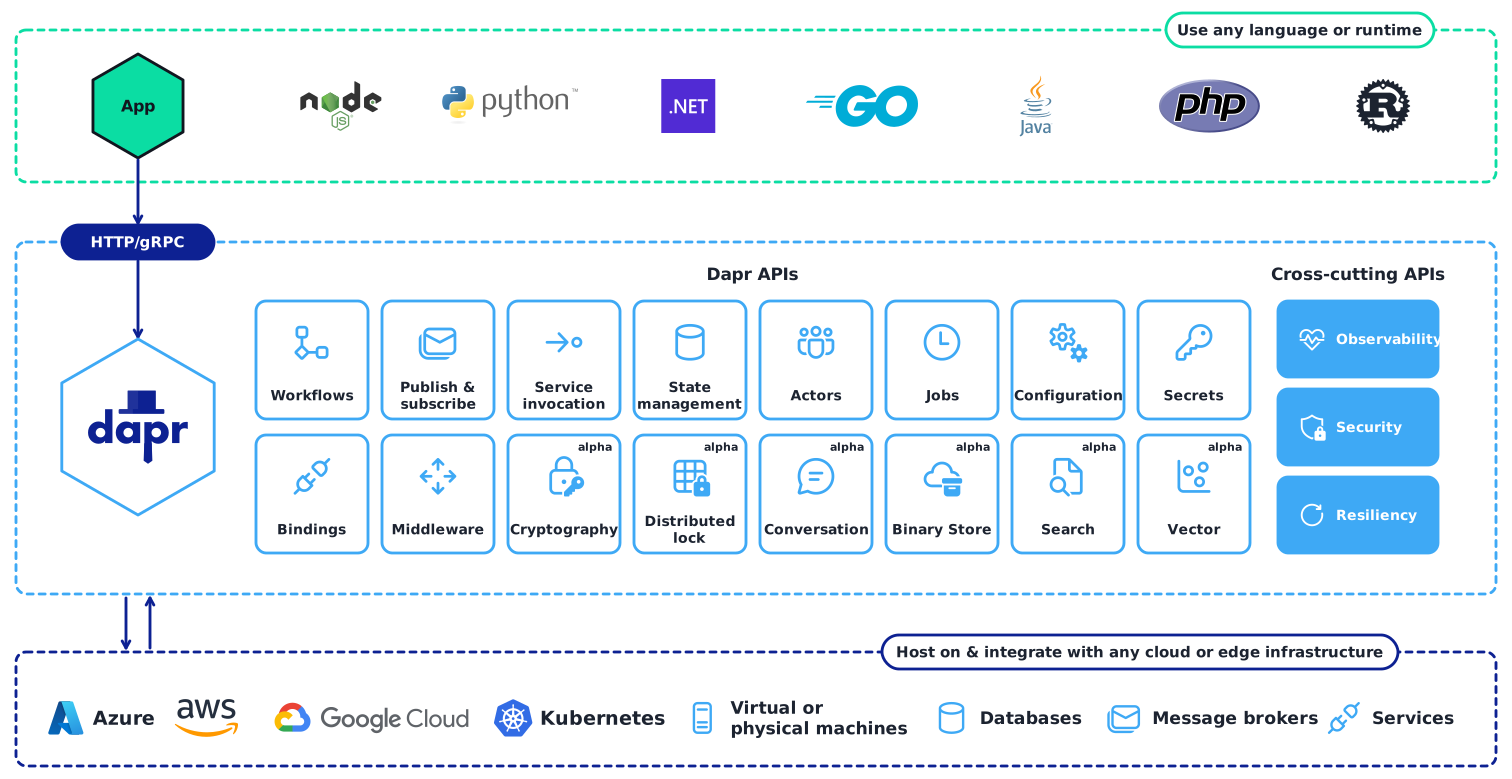
With the current wave of cloud adoption, web + database application architectures (such as classic 3-tier designs) are trending more toward microservice application architectures, which are inherently distributed. You shouldn’t have to become a distributed systems expert just to create microservices applications.
This is where Dapr comes in. Dapr codifies the best practices for building microservice applications into open, independent APIs called building blocks. Dapr’s building blocks:
- Enable you to build portable applications using the language and framework of your choice.
- Are completely independent
- Have no limit to how many you use in your application
Using Dapr, you can incrementally migrate your existing applications to a microservices architecture, thereby adopting cloud native patterns such scale out/in, resiliency, and independent deployments.
Dapr is platform agnostic, meaning you can run your applications:
- Locally
- On any Kubernetes cluster
- On virtual or physical machines
- In other hosting environments that Dapr integrates with.
This enables you to build microservice applications that can run on the cloud and edge.
Microservice building blocks for cloud and edge
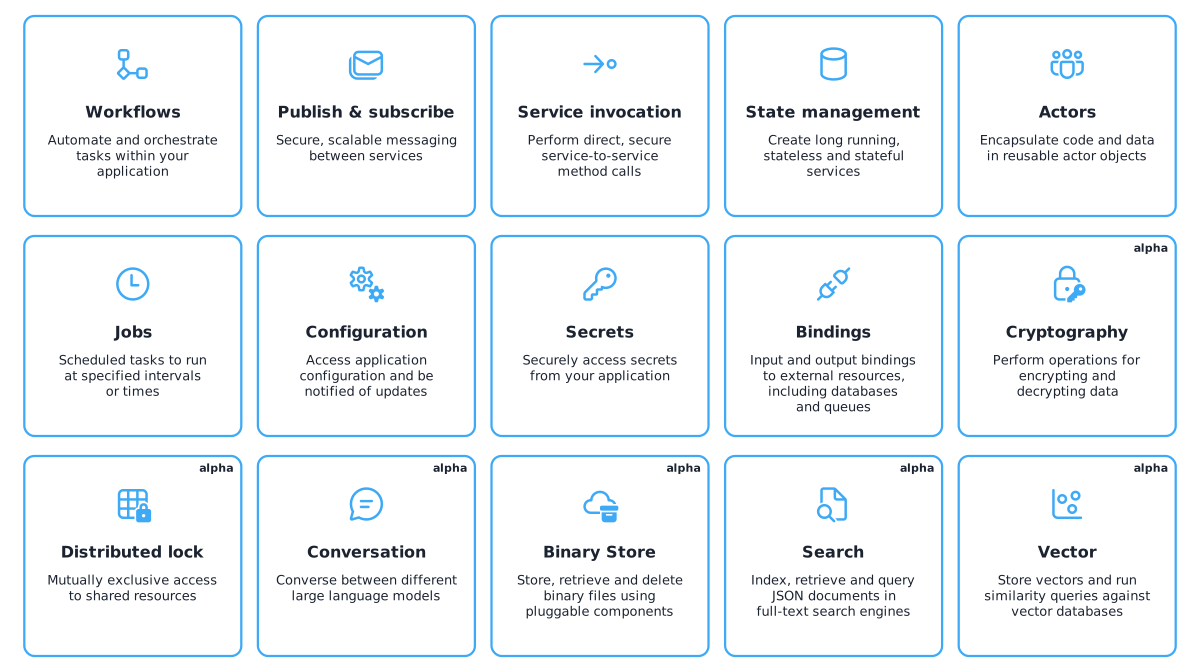
Dapr provides distributed system building blocks for you to build microservice applications in a standard way and to deploy to any environment.
Each of these building block APIs is independent, meaning that you can use any number of them in your application.
| Building Block | Description |
|---|---|
| Workflows | Dapr’s durable execution engine for defining long-running, persistent processes or data flows that span multiple microservices, guaranteeing each step runs to completion despite failures. The workflow API can be combined with other Dapr building blocks, and workflow histories can be cryptographically signed and verified. |
| Service-to-service invocation | Resilient service-to-service invocation enables method calls, including retries, on remote services, wherever they are located in the supported hosting environment. |
| Publish and subscribe | Publishing events and subscribing to topics between services enables event-driven architectures to simplify horizontal scalability and make them resilient to failure. Dapr provides at-least-once message delivery guarantee, message TTL, consumer groups and other advance features. |
| State management | With state management for storing and querying key/value pairs, long-running, highly available, stateful services can be easily written alongside stateless services in your application. The state store is pluggable and examples include AWS DynamoDB, Azure Cosmos DB, Azure SQL Server, GCP Firebase, PostgreSQL or Redis, among others. |
| Binary Store | The binary store API enables you to store, retrieve, and delete files that are too large for a state store. File content is streamed between your application and the configured store rather than buffered in the Dapr sidecar as a JSON value. |
| Resource bindings | Resource bindings with triggers builds further on event-driven architectures for scale and resiliency by receiving and sending events to and from any external source such as databases, queues, file systems, etc. |
| Actors | A pattern for stateful and stateless objects that makes concurrency simple, with method and state encapsulation. Dapr provides many capabilities in its actor runtime, including concurrency, state, and life-cycle management for actor activation/deactivation, and timers and reminders to wake up actors. |
| Secrets | The secrets management API integrates with public cloud and local secret stores to retrieve the secrets for use in application code. |
| Configuration | The configuration API enables you to retrieve and subscribe to application configuration items from configuration stores. |
| Distributed lock | The distributed lock API enables your application to acquire a lock for any resource that gives it exclusive access until either the lock is released by the application, or a lease timeout occurs. |
| Cryptography | The cryptography API provides an abstraction layer on top of security infrastructure such as key vaults. It contains APIs that allow you to perform cryptographic operations, such as encrypting and decrypting messages, without exposing keys to your applications. |
| Jobs | The jobs API enables you to schedule jobs at specific times or intervals. |
| Conversation | The conversation API enables you to abstract the complexities of interacting with large language models (LLMs) and includes features such as prompt caching and personally identifiable information (PII) obfuscation. Using conversation components, you can supply prompts to converse with different LLMs. |
| Search | The search API enables you to index, retrieve, and query documents in full-text search engines through one portable API. Using search components, you can swap search engines without changing your application code. |
| Vector | The vector API enables you to store embeddings and run similarity queries against vector databases through one portable API. Using vector components, you can swap vector databases without changing your application code. |
Cross-cutting APIs
Alongside its building blocks, Dapr provides cross-cutting APIs that apply across all the build blocks you use.
| Building Block | Description |
|---|---|
| Resiliency | Dapr provides the capability to define and apply fault tolerance resiliency policies via a resiliency spec. Supported specs define policies for resiliency patterns such as timeouts, retries/back-offs, and circuit breakers. |
| Observability | Dapr emits metrics, logs, and traces to debug and monitor both Dapr and user applications. Dapr supports distributed tracing to easily diagnose and serve inter-service calls in production using the W3C Trace Context standard and Open Telemetry to send to different monitoring tools. |
| Security | Dapr supports in-transit encryption of communication between Dapr instances using the Dapr control plane, Sentry service. You can bring in your own certificates, or let Dapr automatically create and persist self-signed root and issuer certificates. |
Sidecar architecture
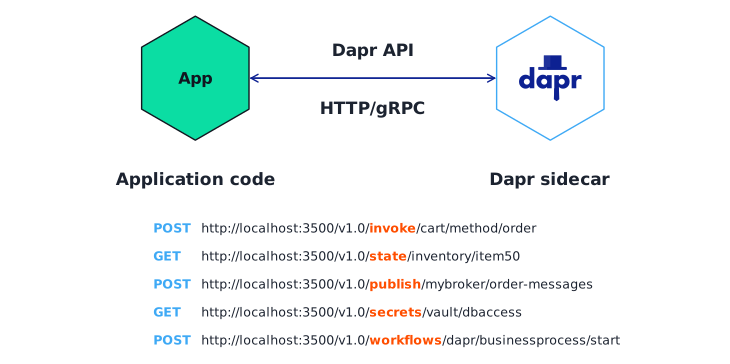
Dapr exposes its HTTP and gRPC APIs as a sidecar architecture, either as a container or as a process, not requiring the application code to include any Dapr runtime code. This makes integration with Dapr easy from other runtimes, as well as providing separation of the application logic for improved supportability.
Hosting environments
Dapr can be hosted in multiple environments, including:
- Self-hosted on a Windows/Linux/macOS machine for local development and in production
- On Kubernetes or clusters of physical or virtual machines in production
Self-hosted local development
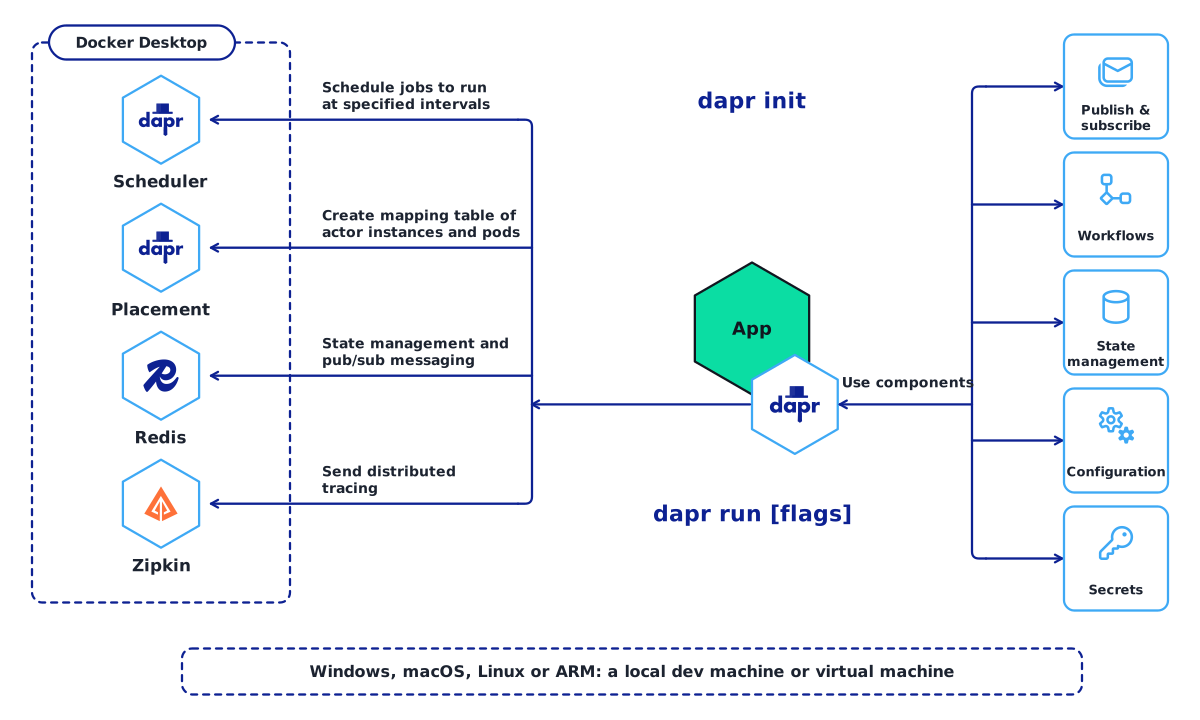
In self-hosted mode, Dapr runs as a separate sidecar process, which your service code can call via HTTP or gRPC. Each running service has a Dapr runtime process (or sidecar) configured to use state stores, pub/sub, binding components, and the other building blocks.
You can use the Dapr CLI to run a Dapr-enabled application on your local machine. In the following diagram, Dapr’s local development environment gets configured with the CLI init command. Try this out with the getting started samples.
Kubernetes
Kubernetes can be used for either:
- Local development (for example, with minikube and k3S), or
- In production.
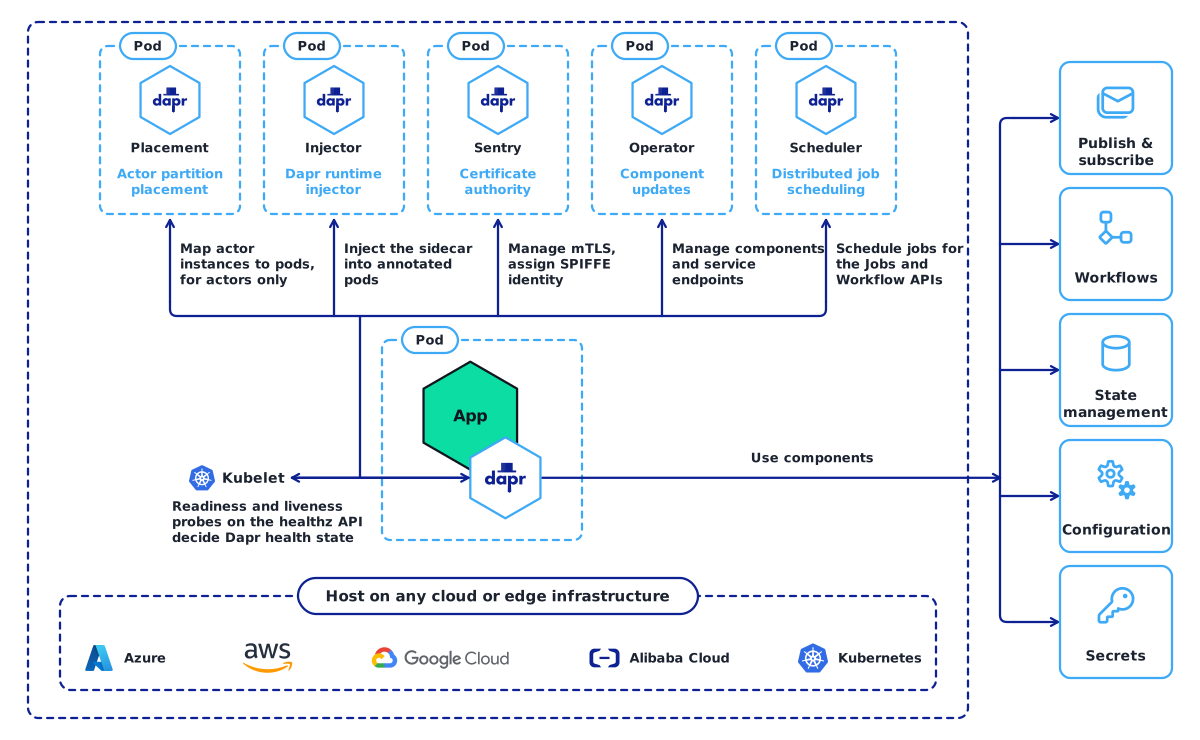
In container hosting environments such as Kubernetes, Dapr runs as a sidecar container with the application container in the same pod.
Dapr’s dapr-sidecar-injector and dapr-operator control plane services provide first-class integration to:
- Launch Dapr as a sidecar container in the same pod as the service container
- Provide notifications of Dapr component updates provisioned in the cluster
The dapr-sentry service is a certificate authority that enables mutual TLS between Dapr sidecar instances for secure data encryption, as well as providing identity via Spiffe. For more information on the Sentry service, read the security overview
Deploying and running a Dapr-enabled application into your Kubernetes cluster is as simple as adding a few annotations to the deployment schemes. Visit the Dapr on Kubernetes docs.
Clusters of physical or virtual machines
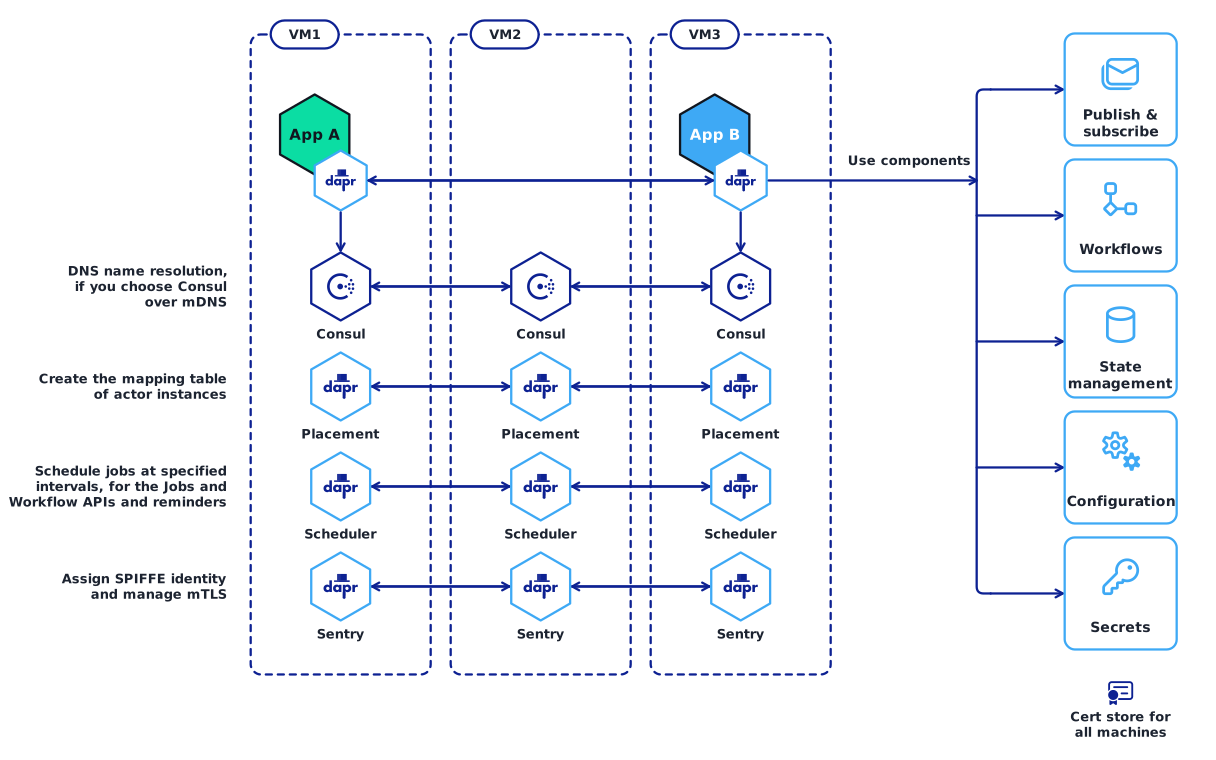
The Dapr control plane services can be deployed in high availability (HA) mode to clusters of physical or virtual machines in production. In the diagram below, the Actor Placement and security Sentry services are started on three different VMs to provide HA control plane. In order to provide name resolution using DNS for the applications running in the cluster, Dapr uses multicast DNS by default, but can also optionally support Hashicorp Consul service.
Developer language SDKs and frameworks
Dapr offers a variety of SDKs and frameworks to make it easy to begin developing with Dapr in your preferred language.
Dapr SDKs
To make using Dapr more natural for different languages, it also includes language specific SDKs for:
- Go
- Java
- JavaScript
- .NET
- PHP
- Python
These SDKs expose the functionality of the Dapr building blocks through a typed language API, rather than calling the http/gRPC API. This enables you to write a combination of stateless and stateful functions and actors all in the language of your choice. Since these SDKs share the Dapr runtime, you get cross-language actor and function support.
Developer frameworks
Dapr can be used from any developer framework. Here are some that have been integrated with Dapr:
Web
| Language | Frameworks | Description |
|---|---|---|
| .NET | ASP.NET Core | Brings stateful routing controllers that respond to pub/sub events from other services. Can also take advantage of ASP.NET Core gRPC Services. |
| Java | Spring Boot | Build Spring boot applications with Dapr APIs |
| Python | Flask | Build Flask applications with Dapr APIs |
| JavaScript | Express | Build Express applications with Dapr APIs |
| PHP | You can serve with Apache, Nginx, or Caddyserver. |
Dapr Agents
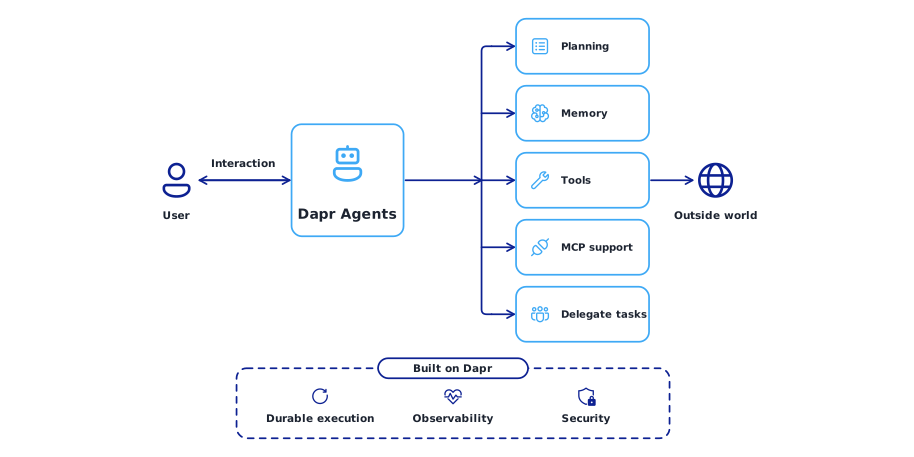
Dapr Agents is a Python framework for building intelligent, durable agents powered by LLMs. It provides agent-centric capabilities such as tool calling, memory management, MCP support and agent orchestration, while leveraging Dapr for durability, observability, and security, at scale.
Integrations and extensions
Visit the integrations page to learn about some of the first-class support Dapr has for various frameworks and external products, including:
- Public cloud services, like Azure and AWS
- Visual Studio Code
- GitHub
Designed for operations
Dapr is designed for operations and security. The Dapr sidecars, runtime, components, and configuration can all be managed and deployed easily and securely to match your organization’s needs.
Dapr supports monitoring tools for deeper visibility into the Dapr system services and sidecars, while the observability capabilities of Dapr provide insights into your application, such as tracing and metrics.